MRO Software Training Time: Why AMOS Takes 3 Months (And How to Avoid It)

How Long Should MRO Software Training Actually Take?
Here's a question I ask every operator I meet: How much time does your team spend training on MRO software?
The answer is always the same: "Too much."
Most operators lose 3–6 months to AMOS training. Another 2–3 months to Maximo implementation. IFS? Add another month of onboarding on top.
That's not training. That's a tax.
And the worst part? It doesn't have to be this way.
Why AMOS & Maximo Training Takes So Long
Before I explain how to eliminate MRO software training entirely, you need to understand why legacy systems require it in the first place.
The answer is simple: by design.
Legacy MRO software—AMOS, Maximo, IFS—were built on a fundamental assumption: complexity is inevitable, so we'll charge for training to manage it.
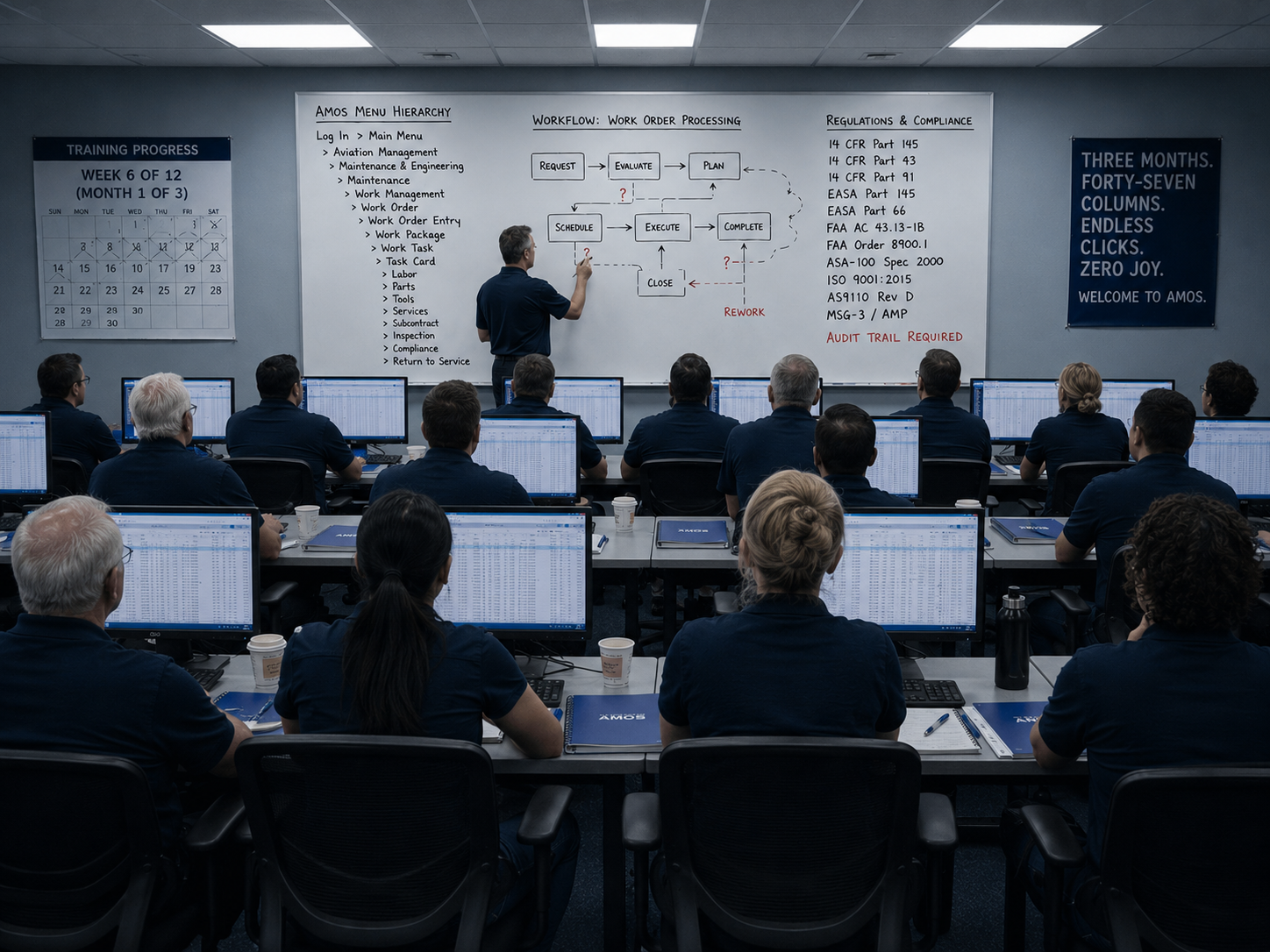
Why AMOS Training Takes 3 Months
AMOS requires navigating 6+ levels of menus to find a compliance check.
Here's the actual workflow:
Level 1: Aircraft module
Level 2: Maintenance menu
Level 3: Check type selection
Level 4: Due date filter
Level 5: Status subcategory
Level 6: Finally — your check
An operator learning AMOS has to memorize this entire path. Not once. Every single day.
By week 2, they forget the sequence. By week 4, they're calling support. By month 3, they might stop needing help.
Training time = 12 weeks. Actual productivity = week 13.
Why Maximo Training Adds Another Layer
Maximo shows 47 columns of data. Which one matters for your task? Good luck figuring it out.
The system displays:
- Task ID
- Check code
- Regulation citation (3 different formats)
- Due date (calendar)
- Due date (flight hours)
- Due date (cycles)
- Last completed date
- Technician assigned
- Status (4 different statuses)
- Parts on order
- Expedited parts status
- And 35 more fields
Operators need 2–3 of these. The other 44 are noise that requires weeks to decode.
The Real Cost of Training-Heavy MRO Software
Here's the math nobody talks about:
Cost Comparison Table:
Traditional Legacy System: 120 hours training per operator, $50K–$100K trainer cost, $150K–$300K consultant support, 6 weeks operational disruption, 2–3x higher error rate, 40–60 support tickets/month
Modern MRO Software: 4 hours training per operator, $0 trainer cost, $0 consultant support, 0 downtime, Same error rate as experienced, 2–3 support tickets/month
Total cost per operator transition:
Traditional: $400K–$600K
Modern: $2K–$5K
When you switch from legacy to modern MRO software, you're not just saving training time. You're saving hundreds of thousands per operator.
Why AMOS & Maximo Training Burden Shouldn't Exist
I've spent 12 years designing software for high-stakes industries. Here's what I've learned:
Training time is a design failure, not a feature.
When an operator needs 3 months to learn your software, it's not because your software is complex. It's because your interface is unnecessarily complicated.
The Design Philosophy Behind Legacy Systems
Legacy MRO software was designed with one principle: visibility over usability.
The theory: "Show everything. Operators will understand everything."
The reality: Operators get lost, skip steps, make mistakes, call support, and waste 12 weeks.
What Good MRO Software Design Actually Looks Like
Modern MRO software is designed with the opposite principle: clarity over complexity.
This means:
#1: Start with the one thing operators need RIGHT NOW
When an operator opens the system, they don't see 47 columns. They see ONE critical view: What's due today?
That's it. Three columns: What, Due when, Action.
An operator understands this in 10 seconds.
#2: Hide complexity until it's needed
Advanced operators need access to deep data. But new operators don't need to see it first.
So the system shows the simple view by default. Advanced details are one click away.
Same system. Different experience. Zero confusion.
#3: Explain compliance in plain language
AMOS shows: "Check required per CAMO.A.1000(b)(3)"
Good MRO software shows: "Landing gear inspection — due after 500 flight hours OR when visual wear shows. This prevents sudden landing gear collapse. Required by CAMO.A.1000(b)(3). Due in 18 days."
Same regulation. Completely different operator clarity.
#4: Smart defaults eliminate decisions
Most operators make the same choices 80% of the time.
So the system assumes the right choice and only asks when exceptions occur.
Instead of 12 decisions to log one inspection, operators make 1 decision. The system handles the rest.
#5: Progressive disclosure serves all skill levels
New operator sees: "Log landing gear inspection?"
Experienced operator clicks "Details" and sees: flight hours remaining, cycles remaining, wear trends, last inspection data, regulatory references, related items, defect history.
How Modern MRO Software Eliminates Training Entirely
Here's the 15-second test I use for any MRO software:
Can a maintenance manager who's never touched it before understand what to do in 15 seconds?
Not 15 minutes. Not 15 days of training. 15 seconds.
AMOS fails this test spectacularly.
Maximo fails this test.
IFS fails this test.
Modern MRO software designed around user reality passes it.
The "Go Live in Hours" Approach
When MRO software is designed for zero training, here's what actually happens:
Week 1 (Modern):
- Day 1–2: Data migration (you handle, operators don't re-enter)
- Day 3: 2-hour walkthrough
- Day 4: Operators start using live
- Day 5: Running production
AMOS approach:
- Week 1–6: Implementation
- Week 7–12: Training
- Week 13–20: Ramping up to production
- Week 21+: Full productivity
That's 20 weeks vs. 5 days.
The FAQ: Training Time Questions Operators Ask
Q: Do all MRO systems really require 3+ months of training?
A: Legacy systems (AMOS, Maximo, IFS) average 12–16 weeks. Modern systems designed for zero training? Hours. The difference is entirely design philosophy, not complexity.
Q: How much does comprehensive MRO software training cost?
A: Traditional training: $400K–$600K per operator (salary, consultant, disruption). Modern MRO software training: $2K–$5K per operator. The difference is enormous.
Q: Can operators really go live without any training?
A: Yes, if the software respects operator expertise and doesn't hide complexity. When compliance is transparent and workflows are intuitive, operators learn by using the system naturally.
Q: What's the industry standard for MRO software implementation time?
A: Legacy systems: 6–12 months (including 3 months training). Modern systems: 4 weeks implementation + hours of onboarding. The "12-month standard" is a legacy industry assumption, not a technical requirement.
Q: How does AMOS implementation time compare to modern alternatives?
A: AMOS: 6–12 months total. Modern MRO software: 4 weeks. That's 3–6x faster. And operators achieve full productivity in days, not months.
The Shift Happening Now in MRO Software
The industry is waking up. Operators are asking: "Why does Slack take 5 minutes to learn? Why does Gmail take 10 minutes? Why should MRO software take 3 months?"
The answer they're getting: It shouldn't.
Good design isn't about making software simpler. It's about making the operator's job simpler.
And that requires understanding what operators actually do—not what software vendors think they should do.
Legacy MRO software chose complexity. They trained operators into it. They charged for it.
Modern MRO software chooses clarity. Operators understand it immediately. They use it from day one.
Key Takeaways: Eliminate MRO Software Training
- AMOS training takes 3 months. Not because operators are slow. Because the interface is unnecessarily complex.
- The real cost of training-heavy software: $400K–$600K per operator. That's not a feature. That's a penalty.
- Modern MRO software requires hours of training, not months. The difference is design philosophy.
- Training time is a design failure. If operators need weeks to learn your software, the interface failed them.
- Go-live timelines: Legacy (20 weeks) vs. Modern (5 days). That's a 16-week productivity gap.
- Operators don't want to become software experts. They want to maintain aircraft. Modern software respects that.
- The 15-second rule: Can a new operator understand your MRO system in 15 seconds? If not, it's a design problem.
Ready to eliminate months of training from your MRO implementation? See how modern MRO software reduces onboarding from 12 weeks to hours.


.png)